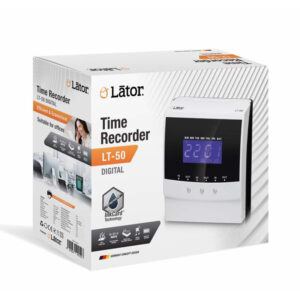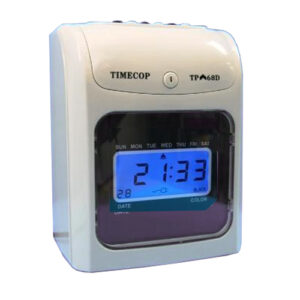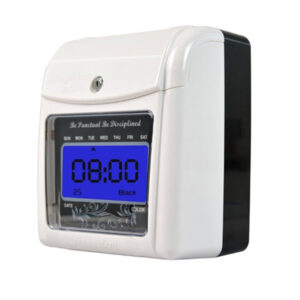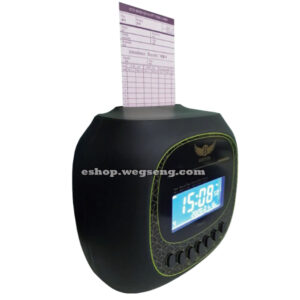
Digital Time Recorder

A digital time recorder works the same way as an analog model — employees insert a paper timecard and the machine stamps the time and date onto it — but with one practical difference: the internal clock is electronic, shown on a digital display, and set via buttons rather than by manually adjusting clock hands. That makes time setting and adjustment noticeably easier, especially when correcting for daylight offsets or after a power interruption.

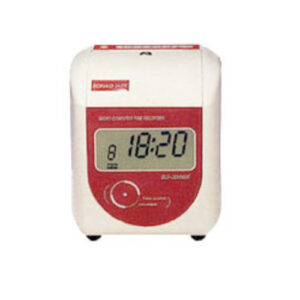
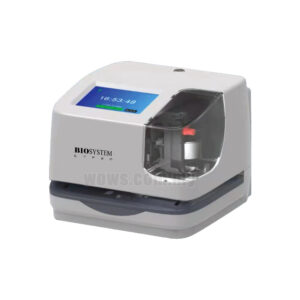
We carry 5 digital time recorders from RM450 to RM1,100 across four brands. The Lator LT-50D, TimeCop TP-68D, and BioSystem BX3300D are the direct digital counterparts to our analog models at the same price points. The BioSystem iClock 12 adds a larger display and extended card capacity. The Ronald Jack RJ-3300N steps up to a more robust build at RM1,100, suited to busier workplaces with higher card volume. Browse all models below, or contact us if you need help choosing. If you prefer a mechanical clock-based model, see our analog time recorders.

Frequently Asked Questions — Digital Time Recorder

How is a digital time recorder different from an analog one?
Both types stamp the time and date onto a paper timecard in exactly the same way — the employee inserts the card and the machine prints the timestamp. The difference is internal: an analog time recorder uses a mechanical clock with physical hands, while a digital model has an electronic clock shown on a numeric display and set via buttons. The printed output on the timecard is the same format for both. The practical advantage of digital is simpler time adjustment — no need to manually turn a knob to move clock hands, just press buttons to set the correct time directly.
Do digital time recorders have battery backup?
Most digital time recorders include a small internal battery — typically a coin cell — that maintains the clock time during power outages. This means the machine remembers the correct time even if mains power is cut overnight, and you won't need to reset the clock every time there's a power interruption. The backup battery does not power the stamping mechanism itself, so employees won't be able to stamp cards during a power cut — but the clock will stay accurate so that when power is restored, timestamps resume correctly without any manual adjustment.
What is the BioSystem iClock 12 and how does it differ from the BX3300D?
Both are digital time recorders from BioSystem at the same RM485 price point. The BX3300D is a standard digital model with a straightforward display and card slot. The iClock 12 features a larger display and is designed to accommodate up to 12 individual timecards stored in a built-in card rack on the machine itself — keeping employee cards organised and accessible at the machine rather than stored separately. If you have a team where cards tend to get misplaced, or you want a tidier punch-in station, the iClock 12's built-in card storage is a useful practical difference.
Why is the Ronald Jack RJ-3300N priced higher than the other models?
The Ronald Jack RJ-3300N is built for heavier daily use. It has a more robust stamping mechanism designed to handle higher card volumes over a longer service life, and the build quality reflects a commercial grade compared to the lighter-duty entry-level models. For a small office punching a few cards a day, the RM450–RM485 models are perfectly adequate. For a factory, warehouse, or any workplace with a larger headcount doing frequent punch-ins and punch-outs across multiple shifts, the Ronald Jack's durability makes it a more practical long-term investment.
How do I set the time on a digital time recorder?
Digital time recorders are set using a button combination — typically a dedicated set or program button that puts the machine into time-setting mode, then up/down buttons to adjust hours and minutes. The exact sequence varies by model, so refer to your machine's manual for the specific steps. The process is generally straightforward and takes under a minute. If you've lost your manual or are unsure, contact us and we can walk you through it for your specific model.
Are timecards from different brands interchangeable?
Not always. Timecards need to match the column layout and card dimensions of your specific machine — the print head stamps at a fixed position, and if the card's column lines don't align with that position, the timestamps will land outside the printed fields and become difficult to read. Some machines use cards with compatible dimensions across brands, but it's safest to use cards specified for your model. We supply compatible timecards for all the models we carry — when ordering, let us know your machine brand and model and we'll confirm the correct card format.